
At about 9.20am on Friday 27 September 1940, the Battle of Britain came down into a residential garden in Walton-on-Thames. Supermarine Spitfire Mk Ia R6767 of No. 92 Squadron RAF crashed at the western end of Station Avenue, close to the railway. Its pilot, 25-year-old Flight Sergeant Charles Sydney, was killed.
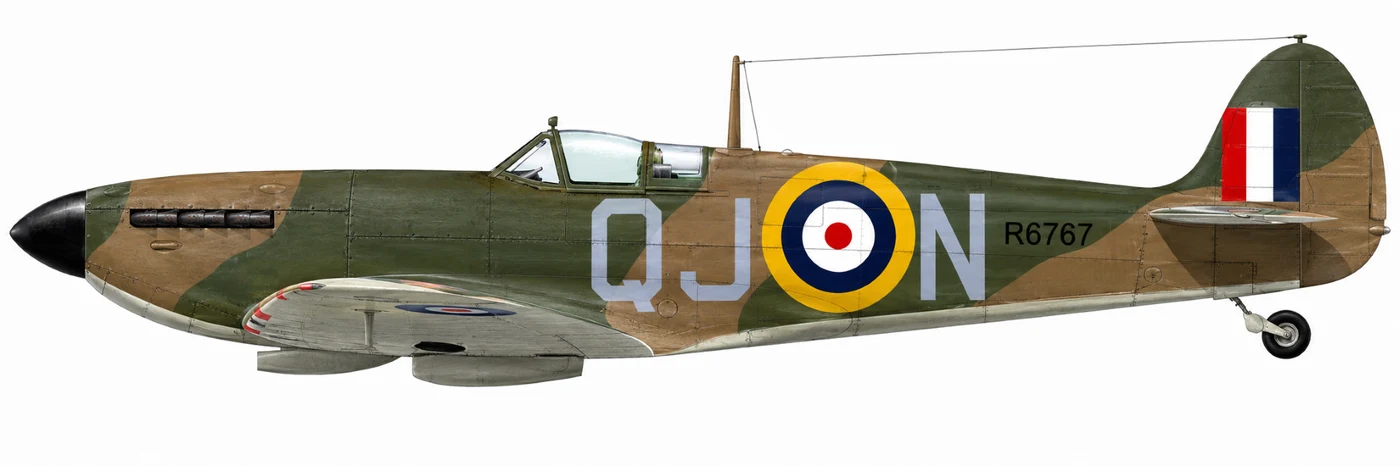
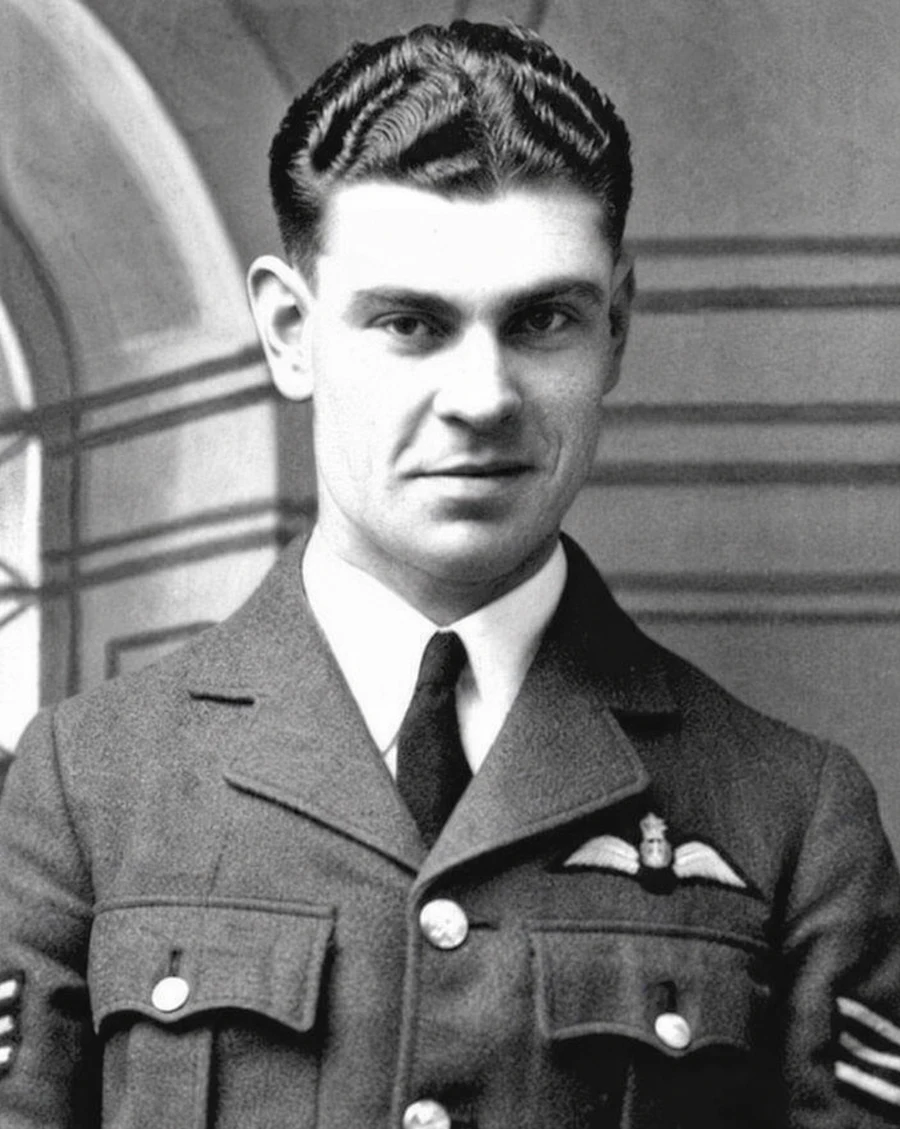
Sydney was not an inexperienced wartime recruit. He had joined the RAF as a teenager in 1931, become a pilot before the war, served as a flying instructor, and returned to operational fighter flying during the Battle of Britain. Twelve days before his death he had been credited with probably destroying a Messerschmitt Bf 109.
The crash is remembered today at Walton Court Gardens, but the surviving evidence allows the story to be reconstructed in considerably more detail than a memorial inscription can carry. This account draws on a contemporary newspaper obituary, No. 92 Squadron’s wartime Operations Record Book, RAF and aircraft-history material, eyewitness testimony preserved by Elmbridge Museum, and later Battle of Britain research. Where sources disagree, that’s noted rather than smoothed over.
The essential facts
- Date: Friday 27 September 1940
- Approximate crash time: 9.20am
- Place: Station Avenue, Walton-on-Thames, Surrey
- More precise location: the garden of a house remembered as St Albans, at the western end of Station Avenue, close to the railway
- Modern location: roughly the area occupied by Gainsborough Court, close to Walton Court Gardens
- Pilot: Flight Sergeant Charles Sydney, RAF service number 564940, aged 25
- Unit: No. 92 Squadron RAF, operating from RAF Biggin Hill
- Aircraft: Supermarine Spitfire Mk Ia R6767, construction number 794
- Cause: recorded in aircraft-history sources as a Bf 109 combat loss; the individual German pilot responsible hasn’t been identified
- Burial: St Mary Cray Cemetery, Orpington, Plot E, Division 3, Grave 130
- Present commemoration: a replacement memorial and the Welcome Home public artwork at Walton Court Gardens
9.20am, Station Avenue
One of the clearest documentary references to the crash appears in Robert Bartlett’s compilation War-Torn Skies over Surrey 1940 (2016), which records: “1940 27 September 0920 Station Avenue, Walton on Thames a Spitfire from 92 Squadron crashed killing Flight Sergeant Charles Sydney aged 25.” Bartlett gives his source as Simon Parry’s War-Torn Skies: Battle of Britain Surrey (2007), p. 104.
The 9.20am time is independently repeated by Elmbridge Museum, which identifies the aircraft as Spitfire R6767 and places the crash near the later Birds Eye and Unilever Walton Court site.
The modern association with Walton Court can make the 1940 landscape hard to picture. The well-known modernist Birds Eye headquarters hadn’t yet been built; that office complex belonged to a later phase in the history of Station Avenue. In September 1940 the western end of the road was residential, with large houses and gardens close to the railway. The aircraft didn’t simply crash “at Walton Court”: the eyewitness evidence allows the impact point to be narrowed much more closely.
Where exactly did the Spitfire crash?
The house called St Albans
The most detailed eyewitness account was given by Jean Margaret Howard MBE, who lived with her parents at Woodhaven, 58 Station Avenue, in 1940. Elmbridge Museum recorded her recollections in 2022.
Howard remembered being in the garden collecting vegetables when a German aircraft passed low overhead. An air-raid warning followed, and she saw British and German aircraft fighting above Walton. She and her parents waited near the back door, ready to use their cellar, when they heard the prolonged sound of an aircraft descending. She remembered the crash as occurring “in the garden two doors away at St. Albans, on the corner”, only a few yards from the main South Eastern Railway line.
That’s an unusually useful piece of local evidence, since it provides four geographical anchors: Howard’s own home was Woodhaven, 58 Station Avenue; the crash was two doors away; the property was called St Albans; and it stood on a corner, very close to the railway. Elmbridge Museum additionally places the site roughly where Gainsborough Court stands today.
Can St Albans be given an exact street number? Not yet, with the evidence currently available. It would be tempting to infer a number simply by counting two doors from No. 58, but that would be poor historical method: house numbering, plot boundaries and the relationship between named houses may have changed since 1940, and part of the area was later redeveloped. The strongest defensible description at present is that the Spitfire crashed in the garden of a house remembered as St Albans, two doors from Woodhaven at 58 Station Avenue, on a corner close to the railway, approximately where Gainsborough Court stands today. A 1939 Register entry, contemporary electoral register, rating book or street directory should eventually be capable of turning the house name into a numbered address; until one of those is examined, this site won’t invent a number.
What residents saw after the impact
A second eyewitness account preserved by Elmbridge Museum describes the Spitfire sitting nose-first in the ground, facing the railway tracks, and not appearing completely destroyed. Police and Air Raid Precautions personnel kept residents away because live ammunition remained aboard; Sydney had already been removed. Howard similarly remembered a sentry posted at the gate and local people kept away from the wreck, probably because of unspent ammunition.
Together, these recollections give a vivid picture: a front-line RAF fighter had come down not on an airfield or open farmland, but in a garden within a residential street, only yards from one of Walton’s principal railway lines. No source found in researching this article records a civilian death at the site, though that shouldn’t be read as proof there were no injuries; a contemporary incident report would settle it either way.
Who was Flight Sergeant Charles Sydney?
Charles Sydney was born in St Pancras, London, on 22 July 1915, the son of Harry Sydney and Eliza Emily Sydney, née Burgess. His family later lived at St Mary Cray in Kent.
Modern summaries often reduce him to a name, an age and an aircraft serial number. A contemporary obituary published in the Bromley & District Times on 11 October 1940 gives a fuller picture: it describes Sydney as the third son of Mr and Mrs H. Sydney of Derry Downs, St Mary Cray. As a child he attended St Mary Cray Council School; at eleven he won a scholarship to Bromley County School, where he remained until he was fifteen, and was then accepted for RAF training.
That matters, because Sydney wasn’t one of the newly trained young pilots who entered Fighter Command only after war broke out. By September 1940 he was a long-serving professional RAF airman. The Battle of Britain London Monument records that he joined the RAF in 1931 as an Aircraft Apprentice, aged around fifteen or sixteen, before later volunteering for pilot training and qualifying as a pilot before the war.
The unresolved two years overseas
The contemporary obituary contains one of the most intriguing clues to Sydney’s life: it states that at nineteen he was “sent abroad for two years”, and that after returning to Britain he underwent pilot training and, in the newspaper’s words, performed that role with “conspicuous success”. No reliable source found in researching this article identifies where those two overseas years were spent. That’s a real gap, since the missing posting potentially covers around 1934 to 1936 and may explain Sydney’s trade, unit and early RAF experience before he became a pilot.
Sydney’s RAF service number was 564940. The National Archives explains that RAF airmen who served after 1939, and men with service numbers above 562875, fall within personnel records transferred from the Ministry of Defence and being catalogued in the newer AIR 85 series; where an individual record hasn’t yet become searchable, a record search can be requested. Sydney’s number is above that threshold, which makes the older digitised AIR 79 inter-war airmen collection an unreliable place to expect his complete record, despite his having joined in 1931. The full service record remains one of the most important outstanding documents for future research: it could potentially establish where Sydney trained as an Aircraft Apprentice, his original trade, the unit and country of his overseas posting, exact promotion dates, his pilot-training establishment, his pre-war postings, and the precise chronology leading to Fighter Command. Until that file is obtained, the location of the overseas posting should be treated as unknown.
Marriage and family
In January 1939, Charles Sydney married Ellen Jane Mary Ryan in Southampton. By the time of his death twenty months later, he was recorded as the husband of Ellen Jane Mary Sydney; his grave record and later memorial sources preserve her name alongside those of his parents. The sources examined for this article don’t provide enough evidence to say anything reliable about children or Ellen’s later life, and that’s not necessary to tell the story of the crash.
From apprentice to fighter pilot
Sydney’s known pre-war and wartime postings show the trajectory of an experienced RAF airman becoming a front-line Spitfire pilot. The Battle of Britain London Monument gives the following sequence after his flying training: No. 1 Army Co-operation Unit; No. 54 Squadron, Hornchurch, from 6 September 1939; No. 66 Squadron, Duxford, from 28 September 1939; No. 6 Operational Training Unit, Sutton Bridge, where he served as an instructor; No. 19 Squadron, Fowlmere, from 18 August 1940; No. 266 Squadron, Wittering, from 24 August 1940; and No. 92 Squadron, Biggin Hill, in September 1940.
The exact date he joined No. 92 Squadron differs slightly between modern sources. The Battle of Britain London Monument and Elmbridge Museum both give 10 September; another Spitfire database gives 12 September. The discrepancy is only two days, but it illustrates why the original personnel record and squadron movement documentation still matter. What’s clear is that Sydney had been with No. 92 Squadron for less than three weeks when he died.
No. 92 Squadron arrives at Biggin Hill
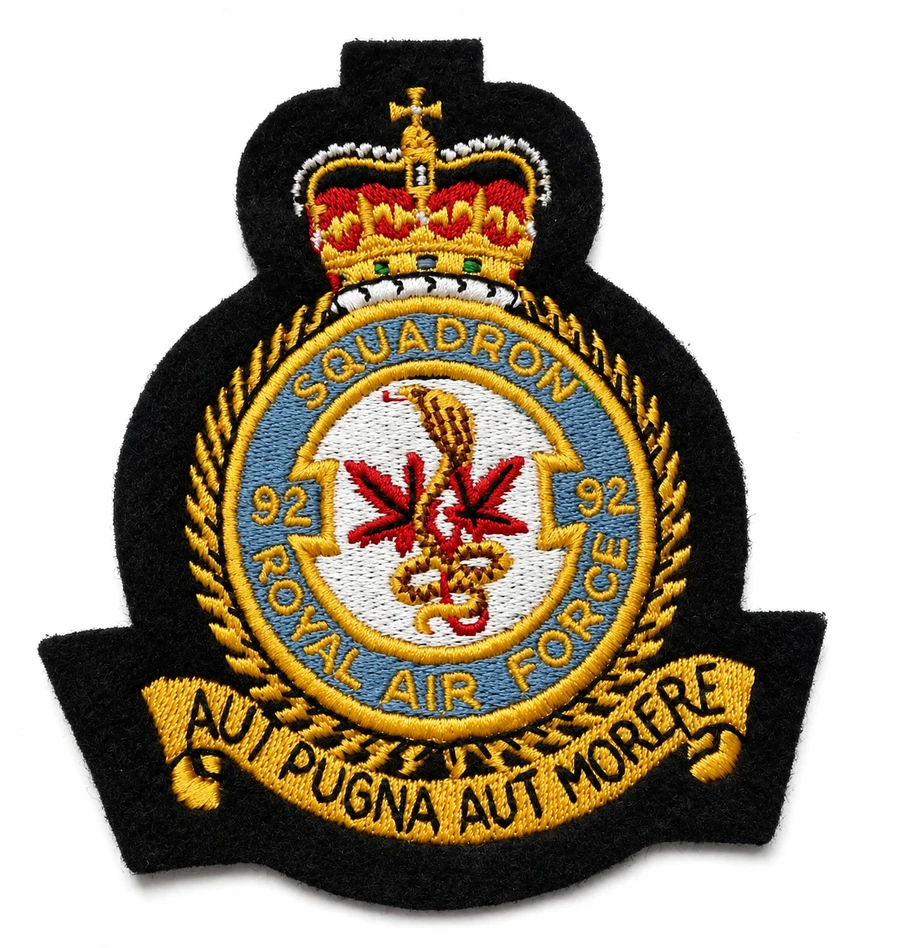
No. 92 Squadron’s Operations Record Book identifies 8 September 1940 as the date its A and B Flights moved to RAF Biggin Hill, one of Fighter Command’s most important sector stations and already a repeated Luftwaffe target. The squadron entered a period of relentless operational flying almost immediately, and Sydney arrived at essentially the same moment. The squadron was equipped with Spitfires and carried the code letters QJ; its surviving Operations Record Book is held by The National Archives in AIR 27/743, described by the Archives as a daily record of unit activity that can include both the Form 540 summary narrative and more detailed material on individual operations.
Battle of Britain Day, 15 September 1940
Twelve days before his death, Sydney took part in the fighting of 15 September 1940, later commemorated as Battle of Britain Day. The Battle of Britain London Monument credits him with probably destroying a Messerschmitt Bf 109.
Modern loss-reconciliation research goes further. A detailed reconstruction of that day’s German casualties identifies a Messerschmitt Bf 109E-1, Werknummer 3619, of 3./JG 53, flown by Unteroffizier Karl-Heinz Feldmann, which had been escorting Dornier Do 17 bombers. Feldmann attempted to attack Spitfires near London, was himself attacked, suffered engine damage, and force-landed at Grand Redoubt between Hythe and Dymchurch, becoming a prisoner of war. The reconstruction specifically directs the reader to the combat report of F/Sgt Sydney, No. 92 Squadron, and another Battle of Britain chronology attributes Feldmann’s aircraft to Sydney at approximately 12.42pm.
That’s strong evidence for the identity of the German aircraft associated with Sydney’s claim, but a distinction is still worth making. The original RAF combat report hasn’t been directly examined for this article. The National Archives confirms Fighter Command combat reports are held in series AIR 50 and can contain the combat time, height, location, enemy type, ammunition expenditure and the pilot’s own narrative; independent citations place No. 92 Squadron’s material within AIR 50/40, though the exact item number for Sydney’s 15 September report hasn’t been established through the sources consulted here. The careful formulation is therefore that Sydney was officially credited with probably destroying a Bf 109 on 15 September, and that modern casualty reconciliation associates his combat report with Bf 109E-1 W.Nr. 3619 of 3./JG 53, flown by Uffz Karl-Heinz Feldmann, who force-landed and was captured. That preserves the discovery without presenting a modern reconstruction as an RAF wartime certainty.
There’s an additional connection between 15 September and Sydney’s final aircraft: a specialist Battle of Britain casualty reconstruction lists Spitfire R6767 of No. 92 Squadron as returning safely after wing damage from a 20mm cannon shell over Canterbury that same day. That source labels Sydney a Flight Lieutenant, which is wrong (he was a Flight Sergeant), and that error is itself a reason to be cautious about treating every field in the reconstruction as primary evidence. Even so, combined with the aircraft’s known allocation to No. 92 Squadron by 13 September, it raises a strong possibility that the same Spitfire which crashed in Walton twelve days later had already been damaged in combat on Battle of Britain Day. It’s a compelling detail, but one that should stay carefully attributed unless the relevant Form 541, combat report or aircraft record is checked directly.
R6767: a Spitfire with a life of little more than three months
The aircraft that ended its life in Station Avenue had itself had an eventful wartime career. Aircraft-history records identify R6767 as a Supermarine Spitfire Mk Ia, construction number 794, fitted with a Rolls-Royce Merlin III engine, first flown on 18 June 1940. It went to No. 6 Maintenance Unit the next day, was allocated to No. 64 Squadron on 18 July 1940, crashed at Hawkinge on 23 July 1940, was salvaged by No. 49 Maintenance Unit, recorded with No. 39 Maintenance Unit by 9 September, allocated to No. 92 Squadron on 13 September, and lost with Flight Sergeant Charles Sydney on 27 September.
The aircraft had therefore existed for only a little over three months when it came down at Walton-on-Thames, and had already crashed once, been recovered, repaired and returned to operational service during the most intense period of the Battle of Britain. Aircraft-history sources describe R6767’s final loss as shot down by a Bf 109 near Maidstone, wording that creates one of the apparent contradictions in the story and needs careful explanation, addressed below.
27 September 1940: Sydney’s final morning
The morning of 27 September saw another major Luftwaffe attempt to penetrate southern England. A modern Battle of Britain chronology reconstructs the first major attack as beginning at about 09:00, when roughly 180 German aircraft, including about 80 bombers and 100 fighters, crossed the coast between Folkestone and Dover; heavy fighting developed over Kent and Sussex as part of the force tried to reach London. The raid included Junkers Ju 88 bombers and fighter escorts, and by about 09:43 the formations were dispersing and withdrawing, though some aircraft had penetrated as far as London. That broader chronology fits closely with the surviving No. 92 Squadron account.
No. 92 Squadron’s wartime Form 540 narrative for 27 September records fine weather with high cloud, ideal for fighters, and states that the first “Scramble” came about 0900 hours. No. 92 Squadron, together with No. 72 Squadron, was sent to intercept large formations of German fighters and bombers, and reported attacking Dornier Do 17s and Heinkel He 111s before their fighter escort could intervene, claiming three bombers and one Bf 109 destroyed, another Dornier probably destroyed, and other bombers damaged. The same record then notes the price paid: “We lost A/F/Lt Paterson and F/Sgt Sydney two experienced pilots, in this combat which took place over a wide area.” Those words, “two experienced pilots”, carry real weight in context: Sydney was only 25, but he’d already spent roughly nine years in the RAF.
A later No. 92 Squadron historical biography gives the scramble more precisely as 08:45, against the contemporary Form 540’s “about 0900”. These aren’t necessarily irreconcilable: a narrative operations diary might round the time, while a more detailed sortie record may preserve the exact take-off, but the individual Form 541 entry for Sydney’s final sortie hasn’t been directly inspected during this research. The responsible conclusion is that No. 92 Squadron appears to have taken off for its first interception at approximately 08:45 to 09:00. With the crash recorded in Walton at about 09:20, Sydney’s final flight may have lasted only around twenty to thirty-five minutes. A future check of the original Form 541 is the best way to tighten that chronology.
From Biggin Hill to Walton-on-Thames
It’s tempting to draw a precise final flight path from Biggin Hill to Station Avenue; the surviving evidence doesn’t yet permit that. What can be said is that No. 92 Squadron took off from Biggin Hill during the first morning interception, fighting a large raid moving inland from Kent that the squadron itself described as taking place over a wide area. Sydney’s Spitfire was lost during that combat, and R6767 came down at Station Avenue at about 09:20. The place where an aircraft was first hit, the point where the pilot lost effective control, and the final crash site could be many miles apart, and that distinction helps explain why later sources give apparently conflicting loss locations.
Kingston, Maidstone, Esher or Walton-on-Thames?
Modern aviation sources don’t agree about the geographical label attached to R6767’s loss. Examples include “shot down over Kingston” in a Spitfire pilot database; “shot down by Bf109 nr Maidstone” in the aircraft production history; “crashed at Esher at 09:40” in a later casualty compilation; and Station Avenue, Walton-on-Thames at 09:20 in the Surrey compilation based on Parry and in Elmbridge Museum’s local evidence.
The final impact site shouldn’t be treated as uncertain simply because these broader aviation descriptions disagree. The local evidence is unusually specific: it names Station Avenue, the house St Albans, Woodhaven at No. 58, the corner location, the railway, the orientation of the wreck, and the approximate modern site at Gainsborough Court. The most likely explanation is that some later databases use approximate locations for the aerial combat or loss rather than the final point of impact, or have inherited errors from earlier compilations. Whatever the exact point at which R6767 was fatally damaged, the aircraft itself crashed in Station Avenue, Walton-on-Thames, and the best-supported local time is about 9.20am.
Who shot Charles Sydney down?
This question can’t currently be answered responsibly with a pilot’s name. Aircraft-history records R6767 as having been shot down by a Bf 109, which is plausible given the circumstances of the morning battle, when No. 92 Squadron was engaging bombers protected by German fighters. But no German victory claim found in researching this article can be matched to Sydney with sufficient confidence across all the necessary variables: time, altitude, geographical position, RAF unit, aircraft type, sequence of combat, and final loss. A large number of RAF and Luftwaffe aircraft were engaged across south-east England that morning, and assigning a named Luftwaffe pilot merely because he claimed a Spitfire in roughly the right region would produce false precision. Spitfire R6767 is recorded as a Bf 109 combat loss, but the Luftwaffe pilot responsible for bringing down Charles Sydney hasn’t been conclusively identified. That’s not a gap to fill by guesswork; it’s an unresolved historical question.
A disastrous day for No. 92 Squadron
Sydney wasn’t the only No. 92 Squadron pilot killed on 27 September. The same morning combat also cost the life of Acting Flight Lieutenant James Alfred Paterson, aged 20, whose Spitfire X4422 came down at Sparepenny Lane, Farningham. Later that day, during its third sortie, No. 92 Squadron lost Sergeant Trevor Guest Oldfield, aged 21. The squadron’s Form 540 records all three losses: Sydney and Paterson belonged to the first morning combat, and Oldfield was lost during the later afternoon fighting. For one fighter squadron to lose three pilots in a single day illustrates the intensity of Fighter Command operations even after the date most famously commemorated as Battle of Britain Day had passed.
Charles Sydney’s funeral
News of Sydney’s death reached the community in which he’d grown up. The Bromley & District Times reported on 11 October 1940 that he’d been killed in combat with the Germans on 27 September, and recorded that he received a military funeral at St Mary Cray Cemetery, attended by RAF officers who conveyed their sympathy to his relatives.
Sydney is buried in St Mary Cray Cemetery, Orpington, Plot E, Division 3, Grave 130. Elmbridge Museum records him as the son of Mr and Mrs H. Sydney of St Mary Cray and the husband of Ellen Jane Mary Sydney. His headstone inscription reads: “He gave his all for his country’s call. God rest his soul in peace.” It’s a deeply personal inscription for a man who’d entered RAF life while still in his teens and died at 25.
Remembering Charles Sydney in Walton-on-Thames
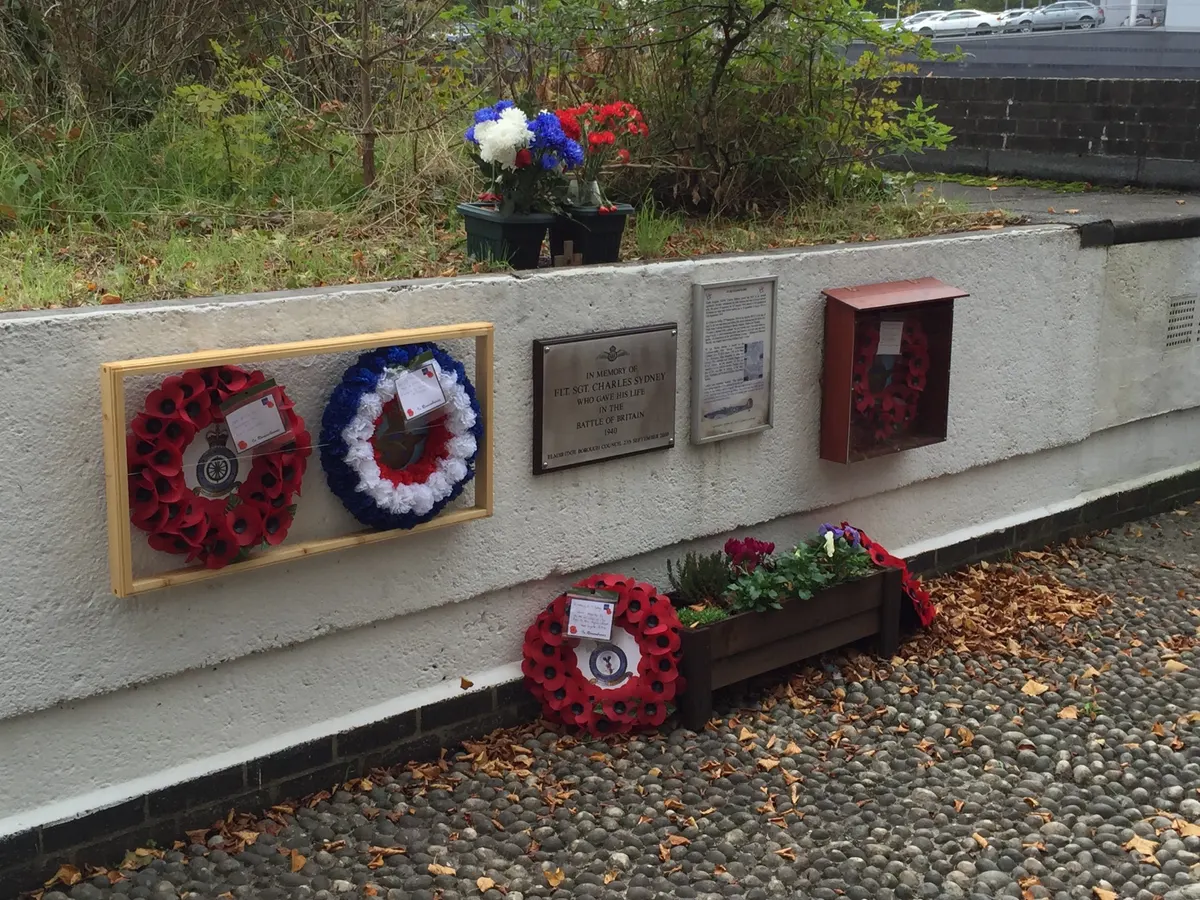
For decades there was little at Station Avenue to tell passers-by that a Battle of Britain pilot had died there. In 2000, Elmbridge Borough Council and Surrey County Council arranged for a memorial plaque to be installed at Walton Court, close to the believed crash location; Jean Howard, whose eyewitness testimony now provides some of the most important evidence about the crash site, was present at the opening ceremony. A memorial bench, carrying a Winston Churchill inscription, was installed on 30 June 2012 to provide a place for reflection. A service was held on 27 September 2015, the 75th anniversary of Sydney’s death, and his great-nephew Tony Sydney was among those associated with the commemorations.
When the Walton Court site was due for redevelopment, a final service at the old memorial location was held on 30 September 2018. Jean Howard attended with members of her family around the time of her 100th birthday, a survival into the twenty-first century that created an extraordinary direct link between present-day Walton and the morning of 27 September 1940.
Walton Court Gardens and the new memorial
The former Walton Court site has since been redeveloped as Walton Court Gardens. In May 2024, Elmbridge Borough Council announced the installation of a new public artwork by sculptor Stuart Melrose, titled Welcome Home. The piece combines two strands of the site’s history: its form incorporates the outline of a Spitfire in memory of the wartime connection, and a penguin referencing the live penguins once kept at the Birds Eye headquarters.
The artwork should be distinguished from the replacement Charles Sydney memorial itself. Crest Nicholson recorded a commemorative service held on Saturday 6 July 2024 following completion of the replacement memorial, attended by the Mayor of Elmbridge, RAF Air Cadets, local residents, and members of Sydney’s family and friends. The redeveloped site now preserves both the broader artistic interpretation of its history and a direct memorial to the pilot whose life ended at Station Avenue.
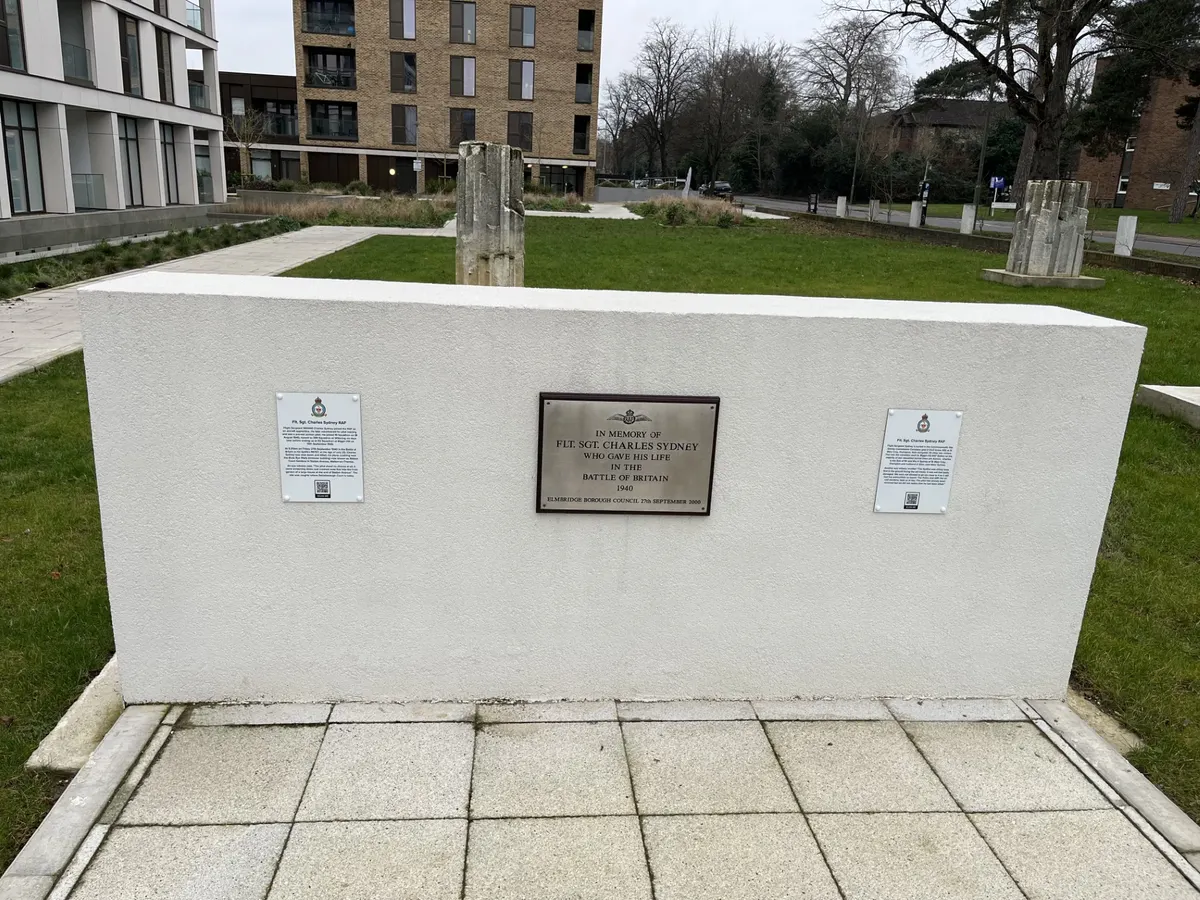
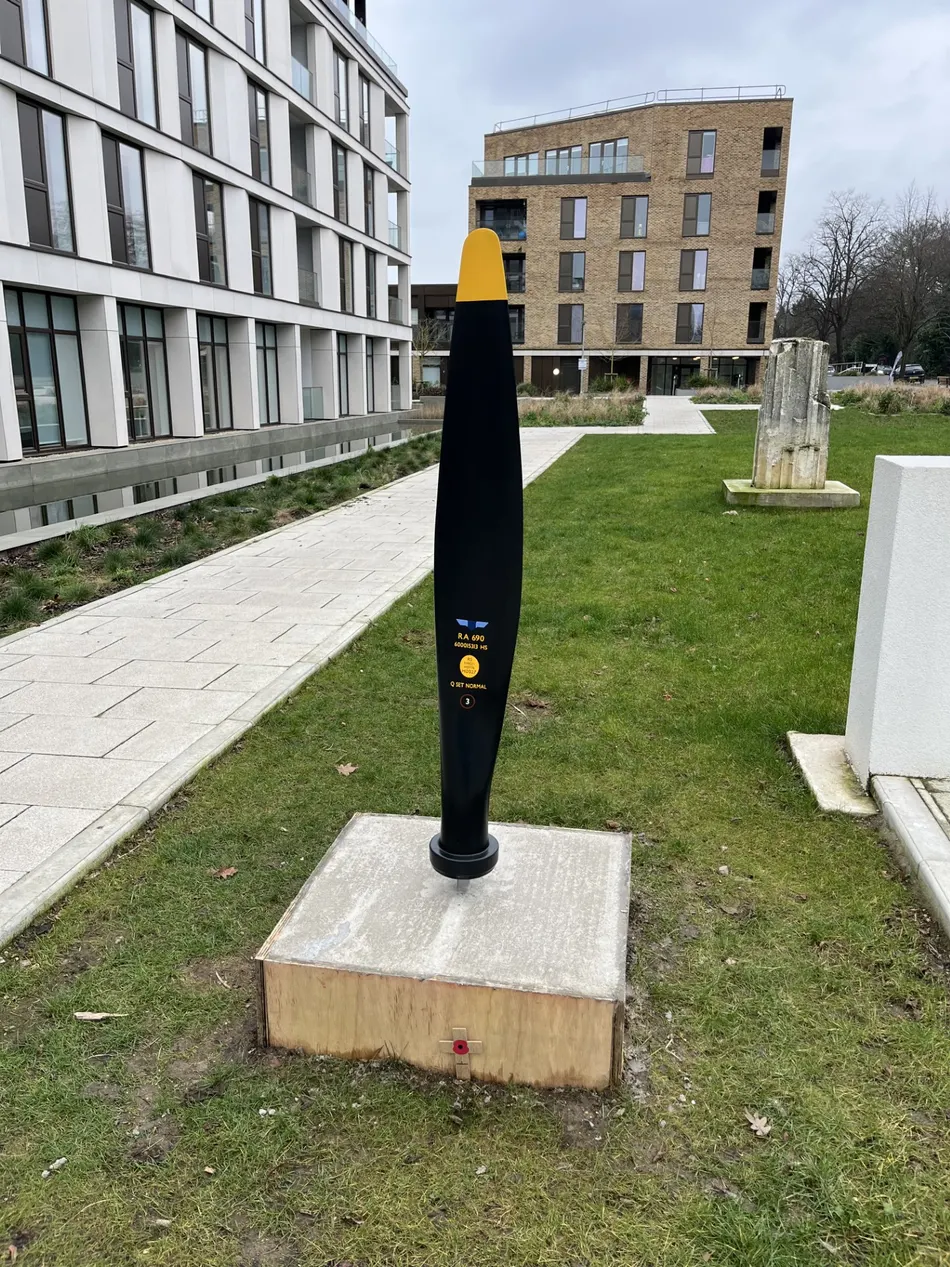
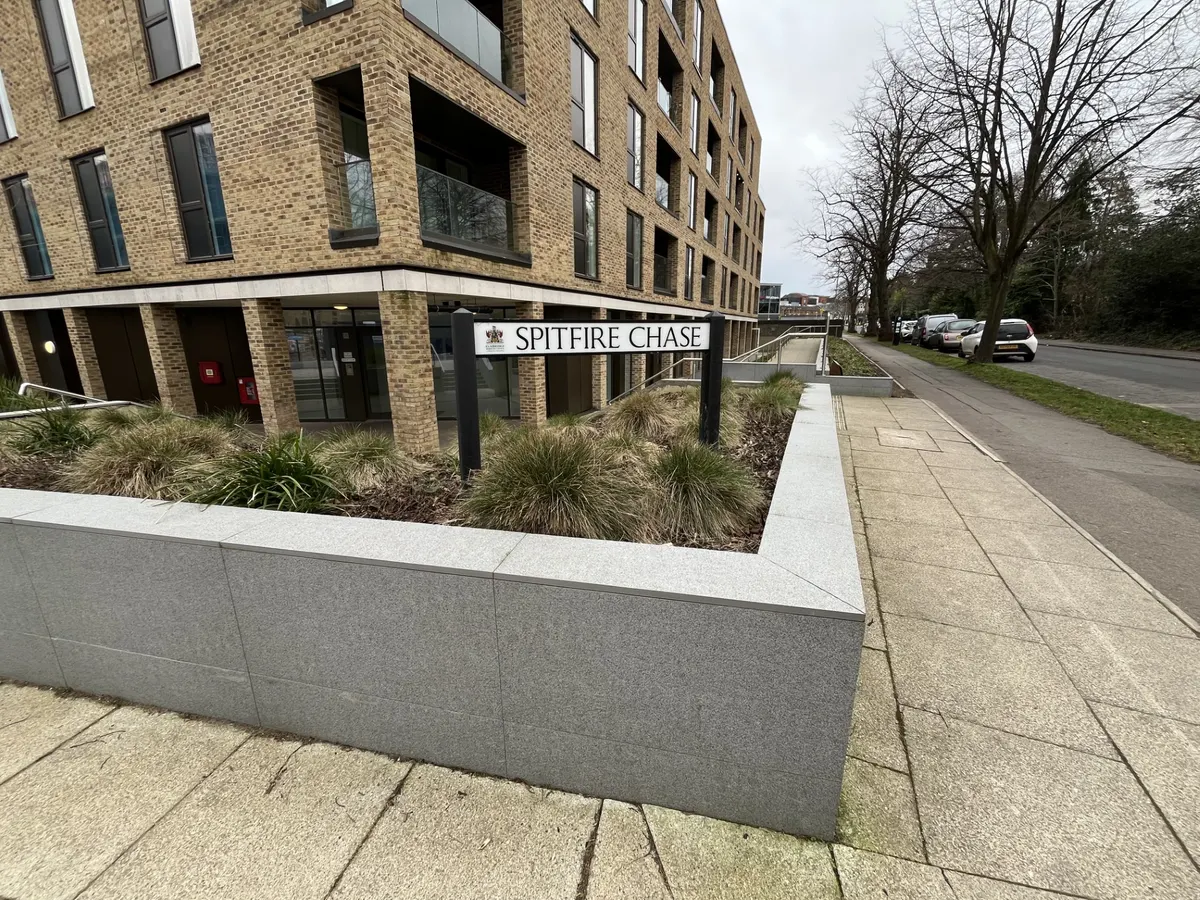
The redevelopment’s street naming carries the memory further still: one of the new roads on the site is called Spitfire Chase.
Why this story matters to Walton-on-Thames
The Battle of Britain is often remembered through the cliffs of the Kent coast, famous fighter stations and the skies over London. The death of Charles Sydney brings that national story down to the scale of a Walton street. On the morning of 27 September 1940, people living in Station Avenue watched British and German aircraft fighting over their homes. Jean Howard was gathering vegetables in her garden; within minutes she and her parents were listening to an aircraft descend towards them, and a Spitfire struck a garden only two doors away.
Its pilot wasn’t anonymous to the RAF. Charles Sydney had entered the service as a teenager, spent years as a professional airman, become a pilot before the war, instructed other aircrew, and fought with several front-line Spitfire squadrons during one of the most dangerous periods in Fighter Command’s history. Twelve days earlier he’d been credited with probably destroying a Bf 109; on 27 September his own aircraft was lost. No. 92 Squadron’s contemporary record didn’t describe Sydney and Paterson simply as casualties. It called them “two experienced pilots.” For Walton-on-Thames, the importance of the story lies precisely in that intersection between national history and a recognisable local place. The Battle of Britain didn’t merely pass over the town; on that September morning, it ended in a garden beside Station Avenue.
Open questions for further research
Several questions remain genuinely unresolved, and would benefit from further archival work:
- Charles Sydney’s transferred RAF service record, likely within AIR 85 at The National Archives, or via a personnel-record search, which could resolve his two-year overseas posting and complete RAF career.
- Sydney’s original 15 September 1940 combat report, expected within AIR 50 (No. 92 Squadron material is known to occur under AIR 50/40), which could confirm the exact time, height, position and his own narrative of the Feldmann engagement.
- No. 92 Squadron’s individual Form 541 entry for 27 September, within the Operations Record Book AIR 27/743, which could confirm the exact take-off time, R6767, and Sydney’s position in the formation.
- Any surviving RAF casualty file for R6767 or Sydney, which the Ministry of Defence’s Air Historical Branch confirms can include aircraft type, squadron, take-off time, cause of loss and crash location for losses from 1940.
- A 1939 Register, electoral register, rating book or street directory entry that could turn the house name St Albans into a numbered Station Avenue address.
- Contemporary Walton, Weybridge or Surrey ARP, police, railway and local newspaper records describing the ground impact, which could establish whether anyone on the ground was hurt and how the wreck and ammunition were dealt with.
Until those records are obtained, this article represents the strongest evidence-led reconstruction achievable from the currently accessible sources, without manufacturing certainty where none yet exists.
Frequently asked questions
When did the Spitfire crash in Walton-on-Thames?
Flight Sergeant Charles Sydney’s Spitfire R6767 crashed in Station Avenue, Walton-on-Thames, at about 9.20am on Friday 27 September 1940, during the Battle of Britain.
Who was the pilot killed in the Station Avenue Spitfire crash?
The pilot was Flight Sergeant Charles Sydney, RAF service number 564940, of No. 92 Squadron RAF. He was 25 years old.
Which Spitfire crashed in Walton-on-Thames?
The aircraft was Supermarine Spitfire Mk Ia R6767, construction number 794.
Where exactly did the Spitfire crash?
Eyewitness Jean Howard remembered it crashing in the garden of a house called St Albans, two doors from her home at Woodhaven, 58 Station Avenue, on a corner only yards from the railway. Elmbridge Museum places the site approximately where Gainsborough Court stands today.
Was Charles Sydney shot down by a German fighter?
Aircraft-history sources record R6767 as a Bf 109 combat loss, but the individual German pilot responsible hasn’t been conclusively identified.
Where is Charles Sydney buried?
He’s buried at St Mary Cray Cemetery, Orpington, Plot E, Division 3, Grave 130.
Is there a memorial to Charles Sydney in Walton-on-Thames?
Yes. A replacement memorial stands at Walton Court Gardens. The development also contains Stuart Melrose’s 2024 Welcome Home sculpture, which references both Sydney’s Spitfire and the later Birds Eye history of the site.
Sources
- Bartlett, R. (2016) 'War-Torn Skies over Surrey 1940, citing Simon Parry, War-Torn Skies: Battle of Britain Surrey (2007), p. 104'. Available at: https://www.surrey-constabulary.com/uploads/1/1/2/9/11293584/war_torn_skies_over_surrey_1940.pdf ↗ (Accessed: 27 July 2026).
- Elmbridge Museum (2024) 'Remembering Flight Sergeant Charles Sydney'. Available at: https://elmbridgemuseum.org.uk/remembering-flight-sergeant-charles-sydney/ ↗ (Accessed: 27 July 2026).
- Battle of Britain London Monument (n.d.) 'The Airmen's Stories: F/Sgt C Sydney'. Available at: https://www.bbm.org.uk/airmen/sydney.htm ↗ (Accessed: 27 July 2026).
- Bromley & District Times (1940) 'Flight-Sergeant C. Sydney, 11 October 1940, p. 7, transcribed by Bromley Historical Times'. Available at: https://www.bromleyhistoricaltimes.co.uk/flight-sergeant-charles-sydney/ ↗ (Accessed: 27 July 2026).
- The National Archives (2026) 'Royal Air Force personnel (guidance on airmen after 1939 and service numbers above 562875, now catalogued in AIR 85)'. Available at: https://www.nationalarchives.gov.uk/help-with-your-research/research-guides/royal-air-force-personnel/ ↗ (Accessed: 27 July 2026).
- No. 92 Squadron RAF (1940) 'Operations Record Book, Form 540, 27 September 1940, AIR 27/743, online transcription'. Available at: https://sirius1935.wixsite.com/92squadron/blank ↗ (Accessed: 27 July 2026).
- The National Archives (n.d.) 'Royal Air Force squadrons (guidance on Operations Record Books in AIR 27 and combat reports in AIR 50)'. Available at: https://www.nationalarchives.gov.uk/help-with-your-research/research-guides/royal-air-force-squadron/ ↗ (Accessed: 27 July 2026).
- Battle of Britain Combat Archive (n.d.) 'Sample pages for 15 September 1940 (Bf 109E-1 W.Nr. 3619, 3./JG 53, Uffz Karl-Heinz Feldmann; also lists R6767 damaged over Canterbury)'. Available at: https://uploads-ssl.webflow.com/5a3134b40672a700015a5d31/638dc4c6b7f0f2030b465b51_Vol13samplepages.pdf ↗ (Accessed: 27 July 2026).
- Battle of Britain Historical Society (n.d.) 'Battle of Britain September 1940, day by day'. Available at: https://www.battle-of-britain.org.uk/history/battle-of-britain-september-1940-day-by-day ↗ (Accessed: 27 July 2026).
- The National Archives (n.d.) 'Royal Air Force combat reports 1939-1945 (AIR 50 research guide)'. Available at: https://www.nationalarchives.gov.uk/help-with-your-research/research-guides/raf-combat-reports-1939-1945 ↗ (Accessed: 27 July 2026).
- AirHistory.org.uk (n.d.) 'Spitfire production page 010 (entry for R6767)'. Available at: https://www.airhistory.org.uk/spitfire/p010.html ↗ (Accessed: 27 July 2026).
- Battle of Britain Historical Timeline (n.d.) 'Friday 27 September 1940'. Available at: https://battleofbritain1940.com/entry/friday-27-september-1940/ ↗ (Accessed: 27 July 2026).
- 92 Squadron (n.d.) 'Biographies of Cobras'. Available at: https://www.92-squadron.com/about-1 ↗ (Accessed: 27 July 2026).
- Aircrew Remembered (n.d.) '27.09.1940 92 Squadron Spitfire I R6622 Sgt Oldfield'. Available at: https://aircrewremembered.com/oldfield-trevor-guest.html ↗ (Accessed: 27 July 2026).
- Aircrew Remembered (n.d.) '27th September 1940 92 Squadron Spitfire I X4422 Fl/Lt Paterson'. Available at: https://aircrewremembered.com/paterson-games-alfred.html ↗ (Accessed: 27 July 2026).
- Rogerson, R. (2015) 'RAF Memorial by Walton Court, Geograph, photograph taken 3 March 2015, CC BY-SA 2.0'. Available at: https://www.geograph.org.uk/photo/4373606 ↗ (Accessed: 27 July 2026).
- Elmbridge Borough Council (2024) 'New public art installation unveiled at Walton Court site, 7 May 2024'. Available at: https://www.elmbridge.gov.uk/news/2024/new-public-art-installation-unveiled-walton-court-site ↗ (Accessed: 27 July 2026).
- Crest Nicholson (2024) 'Crest Nicholson unveils new memorial to Battle of Britain hero'. Available at: https://www.crestnicholson.com/your-crest-experience/latest-news/crest-nicholson-unveils-new-memorial-to-battle-of-britain-hero ↗ (Accessed: 27 July 2026).
- Ministry of Defence, GOV.UK (2023) 'Request information held on the RAF Casualty Files'. Available at: https://www.gov.uk/guidance/request-information-held-on-the-raf-casualty-files ↗ (Accessed: 27 July 2026).