
In 1668, a Walton-on-Thames trader named Thomas King put his own name on money. More than 350 years later, his small copper halfpenny offers a genuinely tangible glimpse into the shops and everyday economy of Stuart Walton, and a matching example is held by the British Museum.
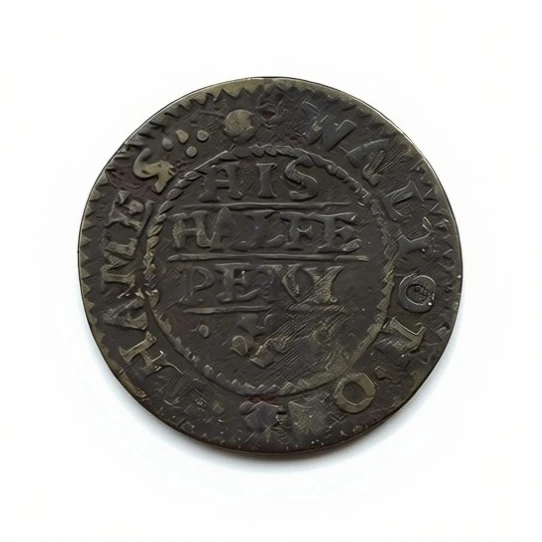
It’s easy to overlook an object this small. Darkened by age and worn from handling, it looks at first like an old coin. Look more closely, though, and a small piece of Walton-on-Thames history emerges. Across its centre are three direct words, “HIS HALFE PENY”, surrounded by the name of the town, “WALTON ON THAMES”. Turn it over and another inscription appears, “THOMAS KING 1668 AT”, around a small heraldic shield.
Together, these details identify the object as a halfpenny trade token issued at Walton-on-Thames by Thomas King in 1668, during the reign of Charles II. The standard published catalogue of Surrey’s 17th-century traders’ tokens, compiled by Wetton and Wetton (1959, p. 46), records the issue as Walton no. 4, Williamson 296, with the device identified as the Grocers’ Arms. The identification is independently supported by the British Museum, whose collection contains another Thomas King token, museum number 1996,0605.181, catalogued as issued at Walton-on-Thames in 1668.
Thomas King’s 1668 halfpenny at a glance
- Issuer: Thomas King
- Place of issue: Walton-on-Thames, Surrey
- Date: 1668
- Denomination: Halfpenny
- Type: Private trade token
- Central device: Grocers’ Arms
- Heraldic blazon: Argent, a chevron Gules between nine cloves Sable
- Reverse inscription: WALTON ON THAMES / HIS HALFE PENY
- Catalogue reference: Wetton Walton 4 / Williamson 296
- British Museum example: 1996,0605.181
This is not an official coin
Although it’s natural to call it a coin, Thomas King’s halfpenny is more accurately described as a trade token. It wasn’t issued by Charles II, Parliament or the Royal Mint; it was private money produced for a local trader.
During the middle decades of the 17th century there was a serious shortage of convenient official small change. The London Museum notes that between roughly 1648 and 1673 the Crown produced almost no small-value coins. Traders responded by pressing their own copper farthings and halfpennies to give as change, since the wealthy could rely on credit but everyone else needed a practical way to do business.
The system depended on trust. A customer accepting one of Thomas King’s halfpennies was, in effect, accepting the reputation of the man whose name appeared on it, and tokens could circulate beyond the issuing business wherever other local traders trusted that reputation. King’s token was therefore several things at once: small change, a form of private credit, and something close to a 17th-century business card. His name identified the issuer, “Walton” identified where he traded, the heraldic device advertised a commercial identity, and “HIS HALFE PENY” stated what it was worth.
Reading the Walton-on-Thames token
Wetton and Wetton’s catalogue records the two sides as “THOMAS KING 1668 AT”, around the Grocers’ Arms, and “WALTON ON THAMES / HIS HALFE PENY” (1959, p. 46). “HALFE PENY” is simply an early spelling of halfpenny, and “WALTON ON THAMES” names the town where the token circulated. For anyone interested in the town’s history, there’s something unusually tangible about seeing Walton named on an object made to circulate here in 1668.
The coat of arms on the token
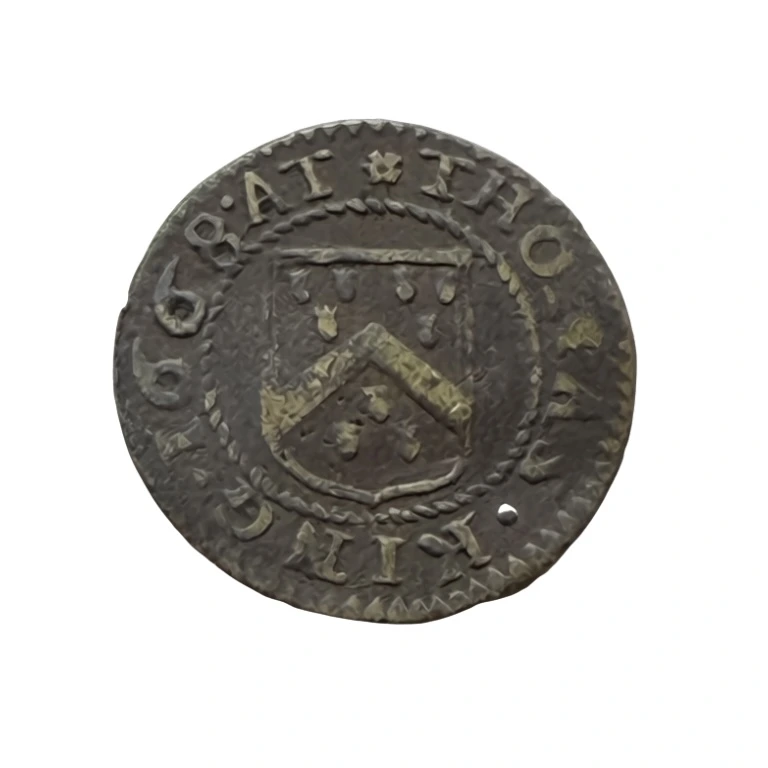
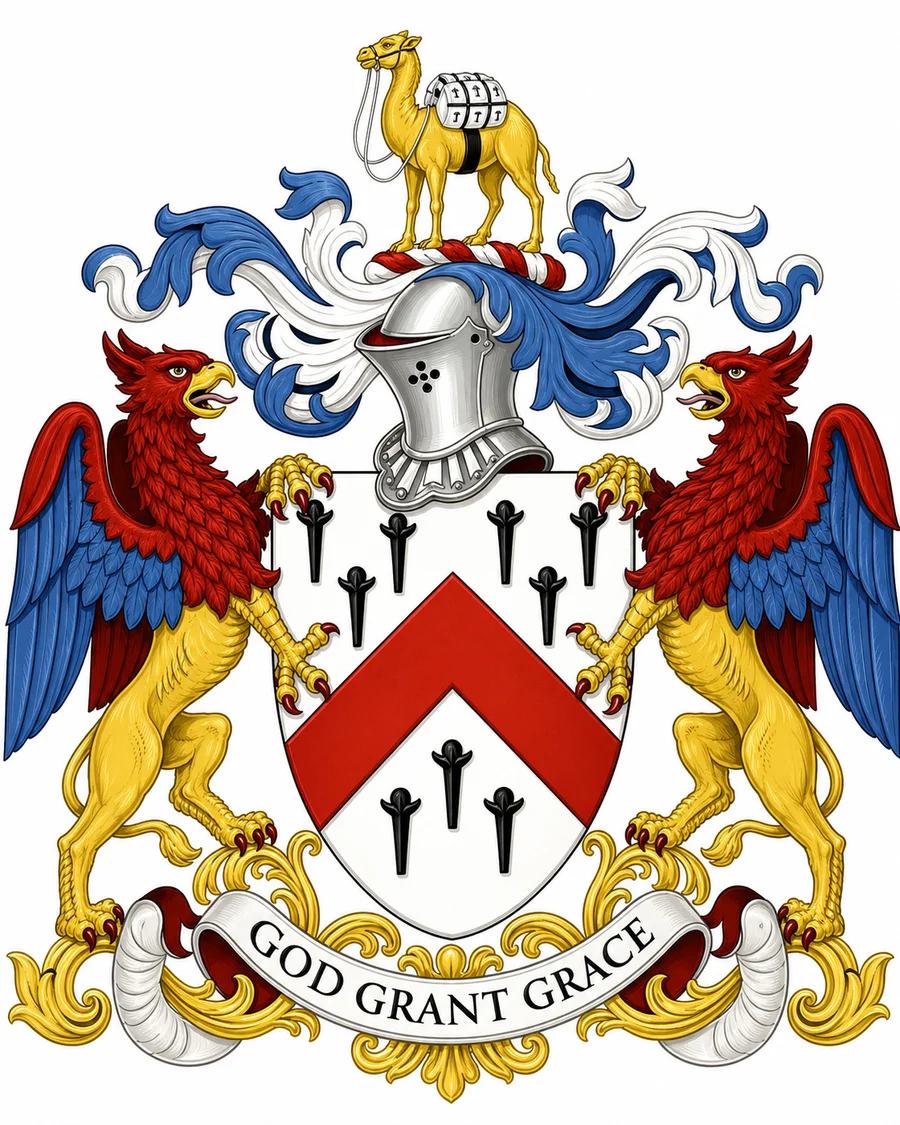
The heraldry is an important clue to Thomas King’s commercial world. The shield is not a personal coat of arms belonging to the King family: it’s the Grocers’ Arms, associated with the Worshipful Company of Grocers of the City of London. Its formal blazon is “Argent, a chevron Gules between nine cloves Sable”, meaning a silver or white shield bearing a red chevron between nine black cloves. The London Museum gives the same blazon for its own 17th-century token bearing the Grocers’ Arms.
The small objects arranged around the chevron are cloves. On a crisp heraldic illustration they’re easy to recognise; on a small copper token worn by more than three centuries of handling, they can resemble pellets or indistinct marks. The choice made sense at the time, since the historic grocery trade dealt in spices and other valuable imported goods, and cloves became a distinctive part of the Grocers’ heraldry.
Was Thomas King a member of the Worshipful Company of Grocers?
Possibly, but the token alone doesn’t prove it. The use of the Grocers’ Arms establishes a strong connection between the token and the grocery trade, or the commercial identity of King’s premises. It doesn’t, by itself, demonstrate that Thomas King was formally a freeman or liveryman of the Worshipful Company of Grocers. Trade tokens often used signs and symbols to identify a business or its premises, so it’s possible the arms functioned as King’s shop sign rather than as proof of livery membership. Until documentary evidence, such as apprenticeship, freedom, livery, parish, probate or property records, can securely connect Walton’s Thomas King with the London company, the careful conclusion is that his token was associated with the Grocers’ Arms, not that formal membership has been proven.
Who was Thomas King of Walton-on-Thames?
Here the halfpenny leaves a genuine local-history mystery. We can say confidently that a Thomas King issued a halfpenny at Walton-on-Thames in 1668; both Wetton and Wetton’s catalogue and the British Museum support that identification. His wider biography, though, hasn’t yet been securely reconstructed.
This matters because a different Thomas King issued 17th-century halfpenny tokens at Cobham, also in Surrey. Wetton and Wetton list the Cobham and Walton issuers separately, and a specialist Noonans Mayfair auction catalogue likewise distinguishes Cobham Thomas King halfpennies from the separate 1668 Walton-on-Thames issue, using different catalogue numbers for each (Cobham: E 32, N 4536, BW.3-; Walton: E 271, N 4718, BW 296). There’s no safe basis at present for assuming they were the same man. Parish registers, wills, probate inventories, manorial records, deeds and the archives of the Grocers’ Company may eventually reveal more about the Walton issuer.
Thomas King’s Walton halfpenny in the British Museum
One of the strongest pieces of evidence for the identification is held by the British Museum. Its online collection records the object as a token, issuer Thomas King, dated 1668, place of issue Walton-on-Thames, museum number 1996,0605.181. That means this small, worn halfpenny can be connected directly with an example preserved in one of the world’s great museum collections.
The British Museum’s Walton-on-Thames collection page also documents other 17th-century token issuers from the town, consistent with Wetton and Wetton’s Surrey catalogue described below, which shows that private tokens were not an isolated curiosity here. Several local traders took part in the 17th-century token economy, leaving behind names and symbols that have survived long after their businesses disappeared.
Other 17th-century Walton token issuers
Wetton and Wetton’s Surrey catalogue (1959, p. 46) records several other Walton-on-Thames issuers alongside Thomas King:
- Charles Erwin, whose halfpenny carries a lion rampant and describes him as being “AT YE WHITE”. The reverse reads “WALLTON VPON THAMES” and “HIS HALFE PENY”.
- Francis Holden, whose Walton token bears the Grocers’ Arms, the same device found on Thomas King’s halfpenny.
- John Holes, who issued a Walton token bearing the Butchers’ Arms and the wording “HIS HALFE PENY”.
- Thomas and William Smith, whose token is also attributed to the Grocers’ Arms, though Wetton and Wetton note uncertainty over this attribution, since the issue has also been claimed for Walton in Suffolk.
One interesting pattern emerges from this list: the Grocers’ Arms are associated with the tokens of Francis Holden, Thomas King, and Thomas and William Smith alike. That concentration raises interesting questions about the grocery and provisions trade in 17th-century Walton, and about the use of trade-company heraldry by provincial shopkeepers generally. It would be tempting to describe all three issuers as members of the Worshipful Company of Grocers, but the token evidence alone doesn’t justify that conclusion. What it does show is that the same recognisable commercial heraldry appeared repeatedly on Walton’s local tokens.
What was a halfpenny worth?
Before decimalisation, the system worked on the basis that 12 pennies made a shilling, 20 shillings made a pound, and so 240 pennies made a pound. A halfpenny was therefore 1/480 of a pound. Converting that fraction into modern currency doesn’t really capture its significance: very small denominations were essential for everyday transactions, and when official small change was scarce, buying inexpensive food and household goods, or simply giving correct change, became genuinely difficult. Trade tokens provided a practical local solution to that problem.
Why did trade tokens disappear?
Thomas King’s token was issued close to the end of the great 17th-century period of private small change. In 1672, only four years after King’s halfpenny, official copper halfpennies and farthings were struck for circulation under Charles II for the first time, carrying the figure of Britannia, according to the Royal Mint Museum. As official copper money became available, the need for locally issued private halfpennies fell away. The London Museum notes that the Crown resumed farthing production in 1672 and prohibited trade tokens, though evidence suggests some continued circulating afterwards anyway. Thomas King’s halfpenny therefore belongs to a short, distinctive period when local reputation could literally become currency.
How rare is Thomas King’s 1668 Walton halfpenny?
The token isn’t unique; several examples are documented. The British Museum holds one, and a further specimen appeared at Noonans Mayfair in December 2015, weighing 0.84g and catalogued as E 271, N 4718, BW 296. It was sold as part of a Surrey lot described as scarce, so that hammer price shouldn’t be treated as a standalone valuation of the Thomas King token specifically.
What matters historically is that the token’s key identifying features survive: Thomas King, 1668, Walton On Thames, His Halfe Peny, and the Grocers’ Arms. Together, they make the attribution to Walton-on-Thames exceptionally persuasive, whatever the condition of any individual surviving example.
A tiny survivor from Stuart Walton
Most of the everyday transactions that took place in Walton-on-Thames in 1668 have disappeared without trace. We don’t know what was bought with any particular halfpenny like this one. Perhaps it bought food; perhaps Thomas King gave it as change across his counter; perhaps it passed from his business to another Walton trader and then into another customer’s pocket. We can’t know. But somebody in or around 17th-century Walton held tokens like this, accepted them in payment, and trusted the name stamped into the metal.
More than 350 years later, Thomas King’s halfpenny still carries the identity of the town in which it circulated: a surviving fragment of the everyday economy of 17th-century Walton-on-Thames, from a period when shopkeepers and tradespeople produced their own small change. Its most evocative feature remains the three simple words struck into its centre in 1668: “HIS HALFE PENY”.
Frequently asked questions
What is the Thomas King 1668 Walton-on-Thames halfpenny?
It’s a privately issued 17th-century halfpenny trade token produced for Thomas King at Walton-on-Thames in 1668, documented in the Surrey token catalogue compiled by Wetton and Wetton and by the British Museum.
Is Thomas King’s 1668 Walton halfpenny in the British Museum?
Yes. The British Museum holds an example catalogued as 1996,0605.181, issued by Thomas King at Walton-on-Thames in 1668.
What does “His Halfe Peny” mean?
It’s a 17th-century spelling of “his halfpenny”, identifying the token’s value and signalling that it was the issuer’s own private token rather than official coinage.
What does “Walton On Thames” mean?
It’s the wording recorded on Thomas King’s token for Walton-on-Thames, documented in Wetton and Wetton’s standard Surrey catalogue.
What coat of arms appears on Thomas King’s halfpenny?
The Grocers’ Arms, not personal arms of the King family. The blazon is “Argent, a chevron Gules between nine cloves Sable”.
Was Thomas King a member of the Worshipful Company of Grocers?
That hasn’t been proven. His use of the Grocers’ Arms strongly associates the token with the grocery trade or with the identity of his premises, but the token alone isn’t evidence of formal membership of the London livery company.
Was the token official legal tender?
No. It was privately issued rather than Royal Mint coinage, but it circulated locally because people trusted the issuer to honour its value.
When did official copper halfpennies appear?
Official copper halfpennies and farthings were struck for circulation under Charles II in 1672, according to the Royal Mint Museum.
Sources
- British Museum (n.d.) 'Walton-on-Thames, Collection online'. Available at: https://www.britishmuseum.org/collection/term/x28629 ↗ (Accessed: 26 July 2026).
- London Museum (n.d.) 'How London's alternative currencies made change'. Available at: https://www.londonmuseum.org.uk/collections/london-stories/how-londons-alternative-currencies-made-change/ ↗ (Accessed: 26 July 2026).
- London Museum (n.d.) 'The Grocers' Arms (object 96.66/309)'. Available at: https://www.londonmuseum.org.uk/collections/v/object-291542/the-grocers-arms/ ↗ (Accessed: 26 July 2026).
- Noonans Mayfair (n.d.) 'Coins, Tokens, Historical Medals and Paper Money, 7-8 December 2015 (Surrey, Walton-on-Thames lot)'. Available at: https://www.noonans.co.uk/archive/past-catalogues/341/catalogue/?layout=list&offset=160&sort=Estimate ↗ (Accessed: 26 July 2026).
- Royal Mint Museum (n.d.) 'Charles II'. Available at: https://www.royalmintmuseum.org.uk/journal/british-monarchs/charles-ii/ ↗ (Accessed: 26 July 2026).
- Wetton, J. L. and Wetton, N. L. (1959) 'The Surrey seventeenth-century traders' tokens'. Available at: https://archaeologydataservice.ac.uk/catalogue/adsdata/arch-379-1/dissemination/pdf/vol_56/surreyac056_029-050_wetton.pdf ↗ (Accessed: 26 July 2026).